Solar maintenance, troubleshooting and system support
Solar System Support & Troubleshooting in Singapore
UTICA® Singapore's Support Centre helps homeowners, businesses, and property owners understand solar panel maintenance, inverter issues, monitoring alerts, system performance, repair requests, safety checks, and Renewable Energy Certificates. Use these resources to identify the right next step before arranging solar PV system support.
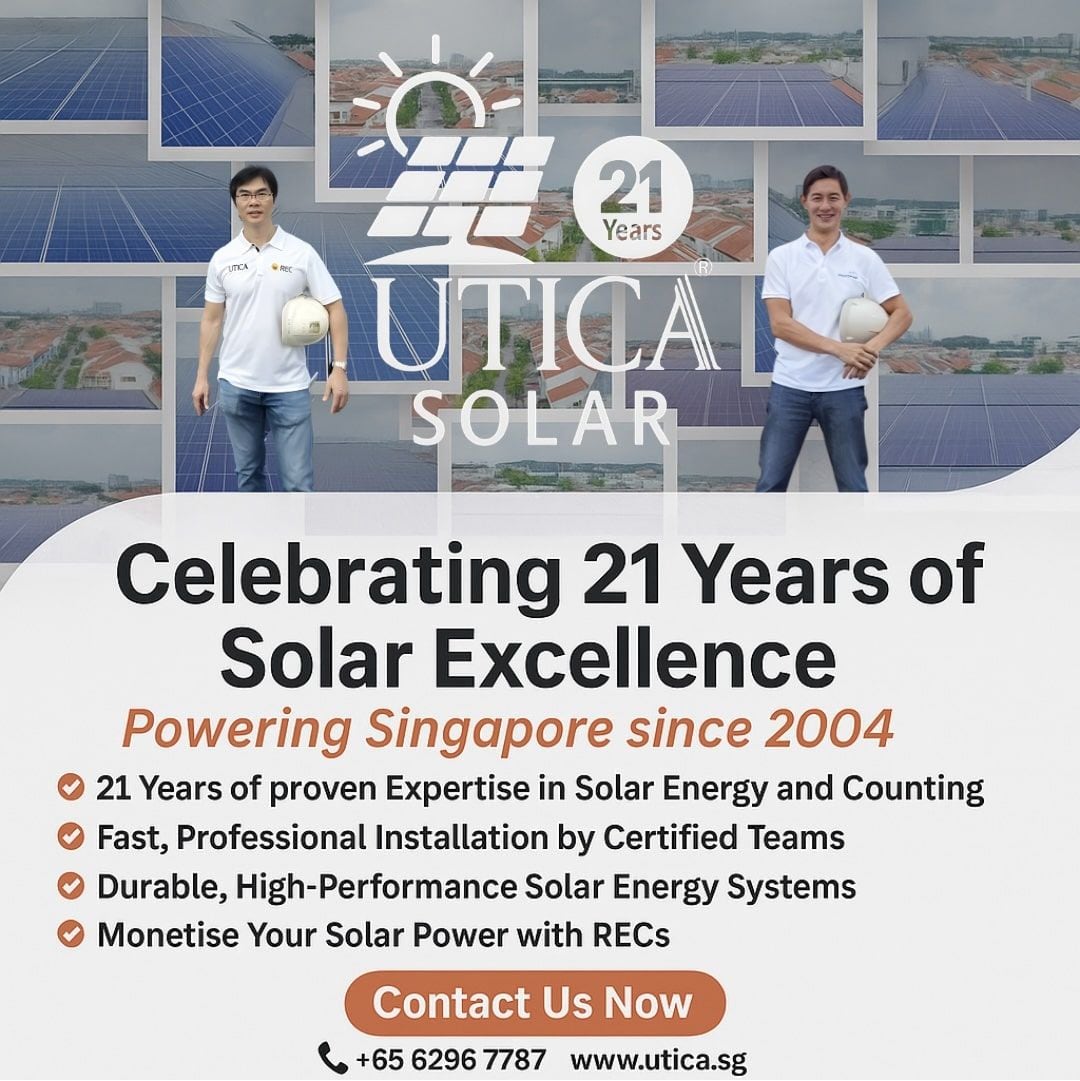
UTICA® 21st Anniversary
Solar PV Maintenance Special
Anniversary maintenance package for residential and commercial solar energy systems up to 20 kWp.
Anniversary price
- Panel light chemical washing
- Rooftop waterproofing touch-ups
- System inspection and performance check
Scaffolding not included. Terms apply.
Recommended reading
Top 10 Solar Panels in Singapore for 2025: UTICA® Independent Guide→
Support topics
Help for solar installation, maintenance, and performance issues
Browse support areas related to solar panels, inverters, monitoring, roof safety, repair checks, compliance, and renewable energy documentation.
Last updated on 9 January 2026, 4:00 PM SGT
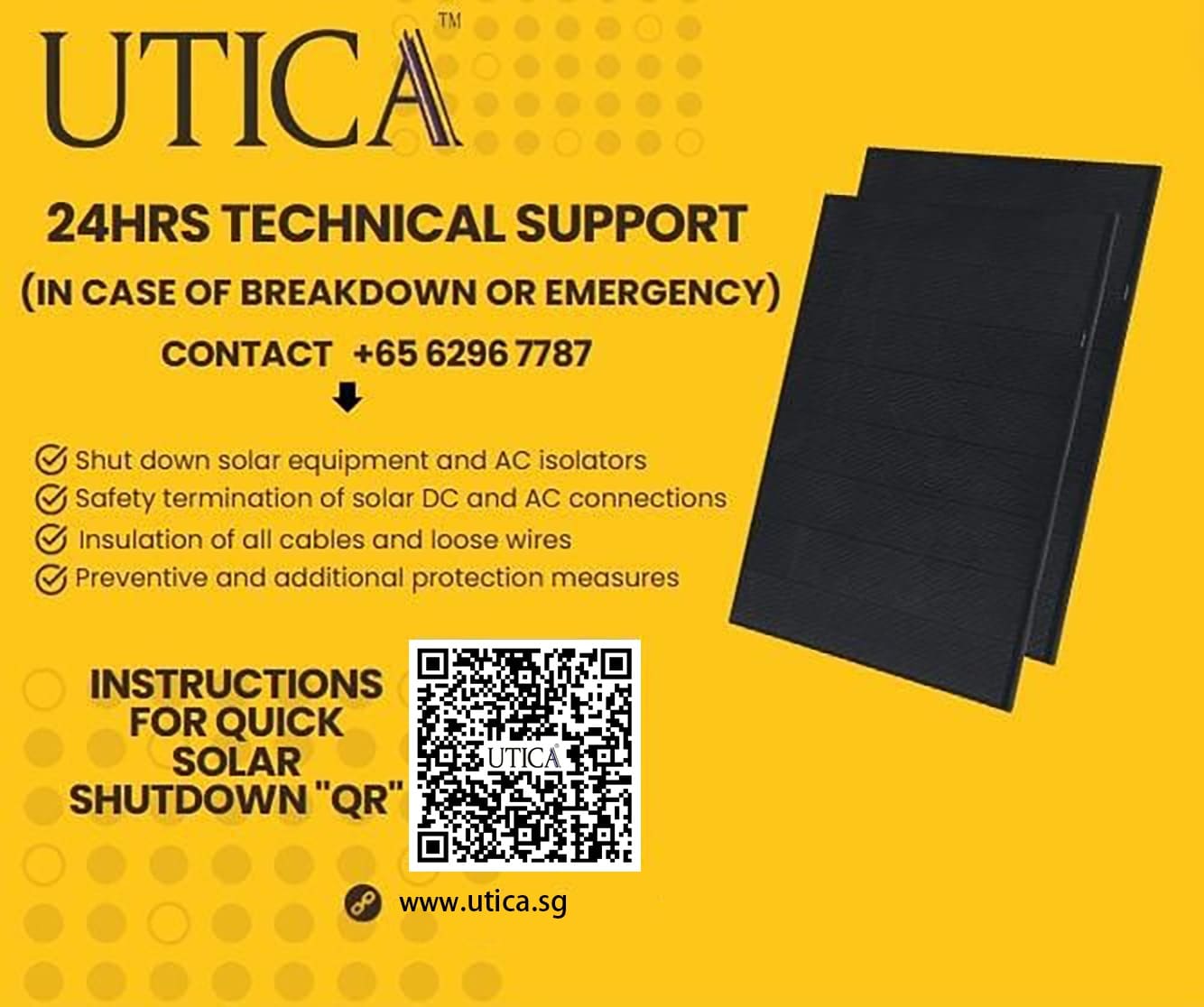
Solar support resources
Solar support FAQs
Find answers for solar panel maintenance, inverter checks, monitoring issues, system performance, and after-sales support in Singapore.
PERFORMANCE
WHAT ARE THE MOST EFFICIENT SOLAR PANELS?
Monocrystalline panels are the most efficient, but we offer a huge variety of highly efficient solar panels here.
HOW DOES A SOLAR CELL WORK?
A solar cell is just a term for each "square" you see on a solar panel. Each solar cell works together with the next as a complete system of the panel.
DO SOLAR PANELS WORK IN THE RAIN?
Rain itself will have no effect on your solar energy system. Solar panels are waterproof, so moisture won't damage them. And, in fact, rain is helpful in that it will wash off some of the dirt and debris that accumulates on the panels over time.
WHY ARE SOME OF MY SOLAR PANELS NOT GENERATING AS MUCH?
The biggest reason why certain solar panels may not be produced to the same degree is the orientation of the panels on your roof. In the United States, North-facing or North-east facing roofs get less sunlight over the course of the entire year than South-facing rooftops. Obstructions that on your solar panels that create shade like trees, lamp posts, chimneys, or other buildings can also make a big impact on how much sunlight your system is exposed to, leading to lower power output.
WILL MY SOLAR PANELS PRODUCE ON RAINY DAYS?
Solar energy systems will capture and convert sunlight even on rainy days. The amount of electricity that they produce will be much less efficient than sunny days. But if your solar energy system is designed properly, it will take under consideration these rainy days since you should be on an annual billing plan called, Net Energy Metering (NEM).
WILL MY SOLAR PANELS WORK AT NIGHT AND ON CLOUDY DAYS?
Solar panels generate electricity using sunlight, so they are most effective during the day when the sun is shining. They produce less energy on cloudy days and don't work at night, but many systems are grid-tied, allowing you to use electricity from the grid when needed.
HOW DO SOLAR PHOTOVOLTAIC (PV) PANELS WORK?
Solar photovoltaic (PV) panels convert sunlight into electricity through the photovoltaic effect. When sunlight hits the panels, it excites electrons in the semiconductor material, creating a flow of electricity.
WILL GOING SOLAR INCREASE MY PROPERTY TAXES?
- Installing solar panels can increase the value of your property. They are considered an attractive feature for potential buyers because they lead to lower electricity bills and contribute to a more sustainable lifestyle. However, in many places, this increase in property value doesn't necessarily translate to higher property taxes. It's advisable to check with local authorities or a tax expert for any specific regulations or incentives related to solar installations in Singapore.
WHAT ARE THE BEST ROOF CONDITIONS FOR SOLAR?
The best setup to install solar on a household roof would be if your home has a large, south-facing or southwest-facing roof that does not have any obstructions that cause shade, with a 30-degree pitch. It would be ideal if the roof was also in new or good condition as well.
IS SOLAR THE CHEAPEST FORM OF ENERGY?
The cheapest renewable energy is indeed solar energy. The International Energy Agency’s World Energy Outlook 2020 stated, “With sharp cost reductions over the past decade, solar PV is consistently cheaper than new coal- or gas-fired power plants in most countries, and solar projects now offer some of the lowest-cost electricity ever seen.” This stayed consistent for the International Energy Agency’s 2021 report, which explained, “In most markets, solar PV or wind now represents the cheapest available source of new electricity generation.” So is renewable energy cheaper in the long run? Absolutely! Beyond the cost benefits of renewable energy, it is also far more environmentally friendly. Renewable energy invests in people and in the planet.
PRICING & COSTS
IS SOLAR ENERGY CHEAPER THAN FOSSIL FUELS?
In most cases, and especially if you factor in the environmental costs, solar energy is indeed cheaper than fossil fuels.
IS SOLAR A SMART INVESTMENT?
Grid-tie solar systems pay for themselves by reducing your monthly electric bill. Grid-tie systems have a 5-10 year payback period depending on factors like local climate, cost of electricity, and approach to installation. Considering panels have a 25-year warranty, there’s plenty of time left over to profit off your investment into your panels. Off-grid systems cost more because they require batteries, but they may still be a good investment compared to other methods of powering the property (like running a power line or using a gas generator).
WHICH IS BETTER – SOLAR LOANS OR SOLAR LEASES?
Solar loans and solar leases each have advantages and disadvantages. Both options reduce your monthly electricity bills and your impact on the environment, but the terms and conditions of each type of agreement are different.
WHAT IS THE DIFFERENCE BETWEEN SECURED SOLAR LOANS AND UNSECURED SOLAR LOANS?
The primary difference between secured and unsecured solar loans is that secured solar loans require that you promise an asset, usually your home, as collateral for the money that you borrow. Unsecured solar loans do not, but their interest rates are generally higher to compensate for the increased risk taken on by the lender.
IS SOLAR ENERGY CHEAPER THAN NORMAL ELECTRICITY?
In many cases solar power is cheaper. To get a good idea on how solar power compares to other sources in your area, check with your local power provider or electric co-op.
HOW LONG BEFORE I NOTICE THE CHANGE IN MY POWER BILLS?
The solar panels start creating electricity immediately after installation. Therefore, you might even see the changes in the next bill you receive.
DO I STILL PAY FOR ELECTRICITY IF I HAVE SOLAR PANELS?
The short answer is maybe. The long answer is that your home first consumes electricity generated by your solar panel system, for which you will not have to pay electricity bills. After that, if you still require additional power, electricity will be drawn from the electricity grid. You will pay your electricity retailer for this electricity. What if your solar panel system generates more electricity than you use? Any excess electricity is sold back to the electricity grid and can be used to offset your electricity and other utility bills. Still, the end result is you’ll pay less for your electricity since you’ll likely consume less electricity from the grid.
HOW MUCH WILL I BE PAID FOR EXCESS SOLAR ENERGY EXPORTED TO THE GRID?
If you use SP Services, you will be paid at the standard electricity tariff rate minus grid charges (~25% of the cost of electricity) which would be around S$0.21/kWh in Q2 2022, where retail electricity tariff is S$0.2794/kWh. If you are with an Open Electricity Market (OEM) retailer, the price that you will be able to sell the excess energy generated by your solar panel system at will be based on the Wholesale Uniform Singapore Energy Price (USEP). USEP rates are determined half-hourly and fluctuate widely but across 2021 has averaged S$0.1963/kWh.
HOW MUCH WILL YOU PAY UP-FRONT?
There are all sorts of different solar offers out there, and the payment structures vary significantly. For instance, you may purchase your system outright, paying the full cost up-front – but by no means is this your only option. There are both loan and lease/PPA options where you can pay $0 down to have your system installed. There are even ‘in-between’ options that allow you to pay a partial amount up-front to save more later on. Generally speaking, the more you pay up-front, the more you will save in the long run (purchasing your system outright will usually save you the most money). However, this may not be the most attractive option for everyone – depending on your situation (and personality) you may see more value in simply saving a smaller amount of money from ‘day one’ as opposed to waiting for your investment to ‘pay itself off’.
DOES SOLAR INCREASE THE VALUE OF MY HOME?
Yes, studies have shown that solar homes sell for 3-5% more than comparable non-solar homes. One NREL study showed that solar-equipped homes sold for $16,995 more on average. So if you want to go solar but aren’t sure whether you’ll stay in your house long enough for the system to pay itself off, you can rest assured that you can recoup most or all of your solar investment when you decide to list your home.
ARE SOLAR PANELS WORTH IT?
Solar panels may involve some high upfront cost, but there are schemes that allow you to simply enjoy instant savings. Some roofs may not be as ideal for solar, but residential solar panels mostly pay back their entire installation cost in an average of 5-8 years. With financial schemes in Singapore allowing you to sell excess electricity to the grid, you can even more easily make back your initial investment.
ARE THERE ANY SOLAR PAYMENT PLANS AVAILABLE?
Purchasing and installing solar panels, especially for large systems, can incur significant upfront costs. That’s why solar PPA or solar leasing exists to help business owners make the switch to solar with almost zero initial investment. If you are a business owner and are interested in the idea of exploring solar PPA or solar leasing
SOLAR PANEL WARRANTY AND MAINTENANCE
Most solar panels come with a 12-year product warranty and 25-year power output warranty. Meanwhile, solar inverters usually have a 5-year product warranty. These warranties generally cover 1-for-1 replacements of any physically defective equipment. This means that if your solar panels require replacement within the warranty period, while the replacement panels will be provided for free, you may still have to pay your installer for the labour costs associated with the replacement work. Maintenance and cleaning costs for your solar panel system usually range from $300 to $500 per visit in Singapore.
IS SOLAR CHEAPER THAN COAL AND OTHER FOSSIL FUELS?
Yes! Solar power has recently become the cheapest energy source in history, as mentioned above. And of the wind, solar, and other renewable energy sources in use in 2020, 62% cheaper than the cheapest new fossil fuel. The director general of the International Renewable Energy Agency, Francesco La Camera, stated, “Today, renewables are the cheapest source of power.”
HOW MUCH WILL SOLAR PANEL MAINTENANCE COST?
Solar panel systems are made of durable tempered glass and require little to no maintenance for the 25 to 35 years that they will generate power. In most cases, you don’t even need to clean your solar panels regularly. If something does happen, most equipment manufacturers include warranties, although warranty terms depend on the company.
HOW MUCH DOES A SOLAR PANEL INSTALLATION COST IN SINGAPORE?
The cost of installation will vary based on several factors. The most important being the number of solar panels being installed. The cost of a solar installation in Singapore ranges from S$15,000 to S$50,000. That said, a good estimate will be S$20,000 as most residential solar panel systems are around 10 kWp (S$2,000/kWp). Besides the number of solar panels installed, roof material, orientation and complexity are other factors that can affect installation costs.
WHAT ARE THE HIDDEN COSTS INVOLVED IN A SOLAR PANEL INSTALLATION?
There are no hidden charges involved in a solar panel installation. The cost that you will incur will be included in the solar installation proposal. That said, there can occasionally be separate charges for scaffolding that may not be included in your solar installation proposal. This is because solar installers generally have to conduct a site visit in order to assess scaffolding costs. Do clarify this with your solar installer beforehand.
WHY IS SOLAR THE CHEAPEST FORM OF ENERGY?
Solar is the cheapest form of energy due to the lower cost of building panels to harvest energy from the sun. Additionally, scientists and engineers are actively researching technology that will create high input for smaller panels, lower costs of fabrication for panels, longer life spans, and improved recycling and reuse methods. It seems that solar energy has a bright future, both for individual households and larger-scale projects.
HOW DO I COMPARE SOLAR QUOTES?
If you have multiple quotes from different solar installers, comparing them can be difficult. Not all solar installers use the same underlying assumptions and metrics when they provide equipment and financing options to homeowners.
HOW LONG IS THE PAYBACK PERIOD FOR A SOLAR PANEL INSTALLATION?
The average payback period for a residential solar panel system is about 6 years. However, this largely depends on the size of your solar panel system, which part of the day you use the most electricity and how much electricity you use overall. Households who have a large solar panel system and use a lot of electricity, especially in the daytime, can see payback periods of as short as 4 to 5 years.
SOLAR INSTALLATION PROCESS
I AM CURRENTLY RENOVATING OR AM GOING TO RENOVATE MY PROPERTY. CAN I INSTALL SOLAR PANELS AT THE SAME TIME?
If you have ongoing or upcoming renovations that involve any roof works, it might be the best time for you to consider installing solar! Solar installers will be able to utilise the same scaffolding that is already set up, allowing you to negotiate for a lower installation cost. Your installer will also be able to incorporate the solar panel’s electrical/cable provisions into your property’s electrical system more easily to conceal any external cables while your property is being built or renovated.
HOW LONG DOES IT TAKE TO COMPLETE A RESIDENTIAL SOLAR PANEL INSTALLATION?
A residential solar panel system installation usually takes 7 to 10 days and is also dependent on weather conditions.
WHAT IS A SOLAR PANEL SYSTEM INSTALLATION PROCESS LIKE?
Before you begin, do ensure that you have conducted a site visit with your selected solar installer and agreed on a finalised solar design and installation contract. The following are the steps involved in a solar panel installation in Singapore. If required, scaffolding will be set up to access your rooftop Solar panels and inverters will be delivered to your property, and you will need to provide safe storage for the equipment before installation works begin Mounting frames for the solar panels will first be placed on your roof. On metal roofs, these are usually attached directly without any penetration. For tiled roofs, roof tiles will be removed temporarily in order to secure the mounting frame before they are returned to their original location. Once the solar panels are fixed onto the mounting frames, the panels are then wired to a solar inverter The solar inverter is then connected to your property’s distribution board, which is also connected to a meter and to the electric grid Finally, solar installers will conduct testing and quality assurance, as well as handle any required paperwork for the solar panel system In Singapore, proper licensing is also required to set up a solar panel installation, as well as, registration with SP Services. Let us help you get in touch with qualified solar installers that will assist you with your solar panel installation.
WHO IS INVOLVED IN THE SOLAR INSTALLATION PROCESS?
The whole solar installation process can be a long-one. You will end up dealing with multiple people during the full start to finish process of installing solar.
WHAT ARE THE COMPONENTS OF A SOLAR PANEL SYSTEM?
A solar panel system usually consists of the following: Solar panels Solar inverter Battery (Hybrid System) Solar panel mounting structure Electrical connectors and wires Isolators Residual Current Circuit Breaker (RCCB) Alternating Current Distribution Board (ACDB) Monitoring system Electrical meter Surge Protection Device (SPD)
CAN THE INSTALLATION BE A DIY PROCESS?
Although it is possible to be a DIY (do it yourself) process, it is advisable to seek the services of an expert in this sector.
WHERE WILL MY SOLAR INVERTER BE PLACED?
Solar inverters are weatherproof and can be placed both indoors and outdoors. However, they have to be placed in a location that allows for a good Wi-Fi connection. Your solar installer will likely survey your property and recommend the best location to place your solar inverter. Placing your solar inverter outdoors will ensure minimal disruption during installation and future maintenance. However, it is often recommended to place your solar inverter indoors. While locating your solar inverters indoors may occasionally result in some excess heat being generated in your home, keeping them indoors in a cooler environment can help to improve their efficiency by 1 to 3%, as well as, extend their durability.
HOW WILL MY SOLAR PANEL SYSTEM BE CONNECTED TO MY HOME?
our solar panel system will be grid-tied. This means that it will be able to channel electricity generated by your solar panels to your home during the day. At night when your solar panels are generating a lot less energy, your home will draw electricity (purchased from your electricity retailer) from the grid automatically.
HOW LONG DOES THE INSTALLATION PROCESS TAKE?
The duration of this process may vary due to various factors such as your solar array’s size, the mounting as well as how your property is.
DO I NEED TO MAKE ANY ALTERATIONS TO MY ROOF BEFORE INSTALLING SOLAR PANELS?
Roof waterproofing is done in some cases to prevent roof leakages. However, this will depend on your roof’s condition and material. A site check will usually be conducted by your solar installer prior to your solar panel installation to determine if alterations are required.
CAN I INSTALL SOLAR MYSELF?
Many of our customers choose to install their own system to save money on their project. Some install the racking rails and panels, then bring in an electrician for the final hookup. Others simply source the equipment from us and hire a local contractor to avoid paying markup to a national solar installer.
SOLAR PANEL SYSTEM MAINTENANCE
HOW OFTEN MUST MAINTENANCE BE DONE ON MY SOLAR PANEL SYSTEM?
Solar panel systems generally require very little maintenance. Solar panels are made from durable tempered glass built to withstand adverse weather conditions (last around 25 to 30 years) and will rarely ever require maintenance. However, no different from air conditioners, we generally encourage homeowners to schedule a preventive maintenance once every 1-2 years. Maintenance fees are charged on a per-trip basis, and often reasonable at around S$300 - S$500.
HOW LONG IS THE WARRANTY ON MY SOLAR PANEL SYSTEM?
Both your solar panels and inverters have their own warranties. The warranty period for most solar panels is between 12 to 25 years. Within this period, your solar installer will replace your solar panels for free if they contain any defects or have efficiency levels that fall below their guaranteed rates. On the other hand, solar inverters are more complex. Therefore, they usually have shorter warranty periods of 5 to 12 years. However, as solar inverters are installed close to your home’s distribution board, they are easily accessible and can be swapped out when required.
WILL, I EVER NEED TO REPLACE MY SOLAR PANELS?
If done right, and by a professional, no harm will come upon your roof. On the contrary, solar panels can act as shields to protect your roof against damage. Some other panels will even make your roof look more beautiful and cooler. There are various solar panels’ mounting options that you can consider, depending on your roof’s design.
IS THE WARRANTY TIED TO THE SOLAR PANEL MANUFACTURER OR THE SOLAR INSTALLERS? WHAT HAPPENS IF MY SOLAR INSTALLER IS NO LONGER IN OPERATION?
Warranties on your solar panels and inverters are registered with the manufacturers. However, you can rely on your solar installers to contact the manufacturers and settle any replacements covered by the warranties on your behalf. On the off chance that your solar installer is no longer in operation, you may have to contact the manufacturer on your own.
HOW DO I BEST MAINTAIN MY SOLAR ENERGY SYSTEM?
A solar PV system typically requires very little maintenance and are incredibly durable. If possible, we do recommend getting your panels cleaned once or twice a year. Using your garden hose should be enough to rinse your panels. If you’d like to do a deeper clean, we recommend using a 1-part vinegar, 2-parts water solution every six months to reduce mineral deposits and keep your panels operating at maximum efficiency.
TECHNICAL
DO MY SOLAR PANEL SYSTEM NEED BATTERIES IN SINGAPORE?
In most cases, no. A solar panel system in Singapore often involves a grid-tied setup that does not require batteries since you can sell excess solar energy generated back into the grid. When there is sunlight, your home will first consume the solar energy generated by your system for power, and automatically draw electricity from the grid if your energy consumption exceeds what is generated. At night, when your system is not generating energy, your house will tap on power from the grid like usual and you’ll not experience any electrical outages. The end result? You save on electricity since you consume much less from the grid.
IS THERE ANY OTHER SOLAR EQUIPMENT AVAILABLE FOR MY PROPERTY?
In the solar power industry, there is much more equipment to benefit from apart from the solar panels. These may include solar water heaters, solar fences, and solar screens, among others. All these things aim to improve the energy efficiency at your property The solar heaters can help heat your swimming pool, while the solar fence is to guard your property against intruders. As for the solar screens, they help to block thermal energy.
WILL SOLAR POWER REACH GRID PARITY?
Yes…in fact it already has! Where have you been?! It really depends on what your time frame is and what utility you’re on. Grid parity basically means that the cost of the power produced by solar is on par with, or cheaper, than what you can buy power from the grid. A typical solar system is guaranteed to last at least 25 years and often last a lot longer than that. This means that if you take the total cost of the solar system and divide it out by all of the kilowatt-hours that it’s going to produce over the next 25 years, the cost will be cheaper than what you could buy that same power from the grid.
IS IT NECESSARY TO HAVE A BACKUP STORAGE?
If you want to enjoy full-time availability of solar electricity, having reliable and ample battery storage is advisable. This will help ensure that you have enough power to use, even when the sun is down. However, you can also connect to the utility grid to ensure you have a continuous supply of power. By joining the grid, you will be selling the extra energy you produce during day time, and when the sun goes down, you can use the grid power.
DO SOLAR PANELS WORK IN A BLACKOUT?
Net metering is the system that utilities use to credit solar energy system owners for the electricity produced by their solar panels. With net metering, you only pay for the electricity that you use beyond what your solar panels can generate. Net metering policies differ from state to state – from Massachusetts to California – so make sure to do your homework ahead of time.
WILL I NEED BATTERIES FOR MY HOME SOLAR ENERGY SYSTEM?
In most cases, no. A solar panel system in Singapore often involves a grid-tied setup that does not require batteries since excess solar energy generated can be sold back into the grid. We do not recommend installing batteries at this point as they are expensive (they can add $10-20K to your system costs) and troublesome to maintain. However, installing battery-ready inverters will allow you to easily include batteries in future when prices fall.
WHICH ARE THE BEST SOLAR PANELS AND INVERTERS FOR MY SYSTEM?
Most installers in Singapore will only use panels and inverters manufactured by Tier 1 manufacturers globally. The most popular solar panel brands in Singapore for residential systems are Jinko, Trina, JA Solar and REC, while common inverter brands are Huawei, SMA, Fimer and Fronius.
SHOULD I ASK FOR A SOLAR MONITORING SYSTEM FOR MY SOLAR PANELS?
If you are interested in receiving detailed information about how much energy your solar panel system is producing, ask your installer about solar monitoring system options. In many cases, solar lease agreements will include free programs to track your system’s performance. If you own your system you may need to pay for one separately.
WHAT DOES THE CONTROLLER REALLY DO?
The controller’s job is to control the amount of energy going into your batteries so they don’t over-charge or over-discharge. It’s just like the voltage regulator in your car. As the battery approaches full charge, the controller slows down the rate of charge and significantly increases battery life. Without one you will need to manually watch the voltage on your batteries and connect and disconnect them from the solar panel manually.
WHAT DO I NEED A CONTROLLER, BATTERIES AND AN INVERTER FOR?
A solar panel generates direct current not the alternating current used in your home. Further, the level of current generated varies in accordance with the amount of energy being converted by the photovoltaic cells in the panel. The controller regulates the power from the solar panel to the batteries so as to increase battery life or reduce damage.
GENERAL
HOW DO SOLAR PANELS WORK?
As sunlight cascades on the solar panels, a chemical reaction takes place and Direct Current (DC) power is produced. The DC power flows to an inverter where the DC power is transformed into Alternating Current (AC) power. This AC power is what the electric grid and your home runs on. The power or energy then flows to power your home or directly to the electric grid. You can also divert the energy from solar panels to a battery to store excess energy. Batteries also operate as DC power.
WHY SOLAR POWER IS THE BEST ENERGY SOURCE?
Renewable. One of the biggest benefits of solar power is that it’s renewable. No one has to go out and drill for solar power. It never runs out, and it’s available anywhere. If the world can get away from utilizing finite sources of energy like fossil fuels, we’ll all be better off. No maintenance. When you invest in a solar energy system, you don’t have to worry about maintenance or moving parts. With wind energy, for example, you have a turbine that is turning non-stop. That requires some kind of lubrication and you’re counting on moving parts never wearing out. With solar, nothing is moving or wearing out. You just install the system and forget about it. Independence. With solar, you can achieve a degree of independence. When you buy your power from the electric company, you’re at their mercy. When they raise their rates, you have to agree to pay them. You can’t really go down the street to another utility. When you install your own solar equipment, it allows you to control the cost of your energy production. You buy the system one time and that’s your total cost for energy.
WHAT ARE SOLAR POWER CELLS?
Solar cells are the main components that comprise solar panels (modules). They are typically small, square-shaped or rectangular pieces that are blue or black. You can see several of them on the front of a solar panel. This is where the “magic” happens with a solar system. The cells are made of silicon and when sunlight hits them, electrons start to move. These moving electrons cause a current to be created inside the cell.
WHAT IS THE DIFFERENCE BETWEEN GRID-TIED AND OFF-GRID SOLAR
Grid-tie systems connect to the public utility grid. The grid acts as storage for the energy produced by your panels, which means you don’t need to buy batteries for storage. This saves a ton of money, which is why we always recommend connecting to the grid if you have a choice. If you don’t have access to power lines at your property, you’ll need an off-grid system with batteries so you can store energy and use it later. There’s a third system type: grid-tied with energy storage. These systems connect to the grid, but also include batteries for backup power in case of outages.
HOW DO I COMPARE SOLAR QUOTES?
If you have multiple quotes from different solar installers, comparing them can be difficult. Not all solar installers use the same underlying assumptions and metrics when they provide equipment and financing options to homeowners.
WHAT IS NET METERING?
Net metering is the system that utilities use to credit solar energy system owners for the electricity produced by their solar panels. With net metering, you only pay for the electricity that you use beyond what your solar panels can generate. Net metering policies differ from state to state – from Massachusetts to California – so make sure to do your homework ahead of time.
WHY IS SOLAR POWER NOT WIDELY USED?
The answer to that is complex, but it boils down to one primary factor. Up until recently, it wasn’t really cost effective for the average person to go solar. The cost of solar 20 years ago was many times more expensive than it is now. For example, a system that now costs $15,000-$25,000 might’ve cost someone $100,000-$150,000. Obviously, an average homeowner couldn’t afford to drop that much money on a solar system. Another big change that’s occurred in recent years is the increased availability of financing mechanisms to help regular people go solar. Instead of having to write a check for a system for thousands of dollars, you can use a solar financing plan, get the system installed, and just make a small monthly payment that’s often lower than your existing electric bill. It’s become more about trading an electric bill for a smaller solar payment instead of coming up with a huge chunk of money upfront. These changes have made solar available to the average person, and thousands of homeowners are making the switch every day.
CAN I INSTALL SOLAR PANELS IN A HDB?
If you live in an HDB flat, you are unfortunately not allowed to install solar panels on your flat’s rooftop. However, HDB does have a 10-year master plan to become more energy-efficient by 2030, with a solar energy target of providing power for 350,000 homes. For instance, 527 HDB blocks in Tanjong Pagar will have solar panels installed. While HDB has no specific rules against installing solar panels in your flat, do note that no installations should be set up outside of your flat unless you get approval. You’ll have to abide by Common Property and Open Spaces rules.
CAN I INSTALL SOLAR PANELS IN A LANDED HOUSE?
Yes! Landed homeowners can easily install and benefit from solar panels in Singapore. For an instant personalised estimate.
WILL SOLAR POWER WORK AFTER AN EMP?
One of the common questions that we get from people preparing for a worst-case scenario is if their solar system will work after an EMP blast. The truth is that, no one really knows, because there hasn’t ever been a large scale EMP attack before. Factors like the location and strength of the EMP blast will play a role in what electronics still work. One thing to keep in mind is that over 99% of solar systems are connected to the utility grid. This means that if the grid goes down, the solar system most likely will not work either.
DO SOLAR PANELS WORK IN A BLACKOUT?
If your solar panel system is connected to the grid, it will shut off in the event of a blackout. This is to prevent emergency responders and electricity utility repair-people from being injured by your panels sending power back to the grid. However, there are certain inverters you can buy that provide backup power in a blackout when paired with a battery.
HOW DOES SOLAR PANELS WORK FOR KIDS?
If you are using solar energy as an electricity source, then children should be kept away as electricity can be dangerous. IF we are just talking a solar powered flashlight or solar phone charger, then it should be completely fine for a child to operate it.
WHAT IS DIFFERENCE BETWEEN POLYCRYSTALLINE AND MONOCRYSTALLINE SOLAR PANELS?
In short, poly means many and mono means one. In regards to solar panels this means that each solar cell is either made with one or many crystals. In general, monocrystalline solar panels are considered to be better quality, but polycrystalline panels are much more affordable.
WHICH SOLAR PANEL IS BEST POLYCRYSTALLINE OR MONOCRYSTALLINE?
Monocrystalline solar panels are more efficient, but in turn can be much more expensive compared to polycrystalline solar panels.
WHAT SOLAR ENERGY REBATES AND INCENTIVES ARE AVAILABLE?
Solar rebates and incentives vary depending on where you live. The most significant is the 26 percent federal investment tax credit (ITC), which allows you to deduct 26 percent of the cost of your solar energy system from your taxes. Some states offer additional tax credits, and certain municipalities and utilities also offer cash rebates or other incentives.
HOW DO SOLAR PHOTOVOLTAIC (PV) PANELS WORK?
Solar panels absorb the sun's energy throughout the day and convert it into direct current (DC) electricity. Most homes and businesses run on alternating current (AC) electricity, so the DC electricity is then passed through an inverter to convert it to usable AC electricity. At that point, you either use the electricity in your house or send it back to the electric grid.
WILL GOING SOLAR INCREASE MY PROPERTY TAXES?
In Singapore, the installation of solar systems will not have any impact on the property tax being imposed. However, we recommend that you consult with your independent tax advisor since our intention is not to provide legal or tax advice.
CAN YOU RUN YOUR WHOLE HOUSE ON SOLAR POWER?
Absolutely, but first you will need to factor in budget and how much energy you use. You will also need to add battery storage to account for the power you would use when the sun is not shining.
IS THE PRODUCTION OF SOLAR PANELS HARMFUL TO THE ENVIRONMENT?
It is a myth that the production of solar panels is bad for the environment. In general, production processes of solar panels are becoming cleaner and cleaner everyday.
CAN I BENEFIT FROM THE EXCESS ENERGY GENERATED BY MY SOLAR PANEL SYSTEM?
Yes! You will be able to enjoy rebates for the export of excess solar energy generated by your solar panel system through SP Services. If you are not currently buying electricity from SP Services, you can still benefit from selling excess electricity back to the grid.
HOW LONG WILL A SOLAR PANEL SYSTEM LAST?
Solar PV systems are designed to be extremely durable and last for at least 30 years. Most solar panels have a warranty period of 25 to 30 years, and inverters have a warranty period of 5 to 12 years. Inverters are usually expected to be replaced at least once throughout the lifetime of the solar system. Some systems have been known to last for close to 40 years now!
IS MY ROOFTOP SUITABLE FOR A SOLAR PANEL INSTALLATION?
Most roofs are suitable for solar panels. However, roofs that are overly sloped or complex would not be the most ideal for solar panel installations. Some examples of complex roofs include ones that face many different directions or have dormer windows. This might leave very little space for solar panel installation and/or make installation challenging. In which case, this will likely incur greater costs and might be less economically feasible.
I AM BUYING ELECTRICITY FROM AN OPEN ELECTRICITY MARKET (OEM) RETAILER, WILL MY SOLAR PANEL INSTALLATION BE LINKED TO MY CONTRACT WITH MY OEM RETAILER?
No, your solar panel installation is not tied to your OEM retailer contract, and you can install solar at any time regardless of your contract end date. Some solar homeowners who generate more solar energy than they consume may choose to switch back to SP Services in order to make a greater profit. They can choose to switch at any time after the end of their existing retail electricity contract.
RISKS OF GOING SOLAR?
When your solar energy system is properly installed and maintained, solar panels and how they generate electricity should not pose any danger to your home. Issues that do arise, are relatively uncommon but are typically related to the installation and operation of a solar energy system. Some issues and risks that have come up historically around a solar PV system include roof leaks, hot spots, and on extremely rare cases, catching fire.
WILL GOING SOLAR INCREASE MY HOMEOWNER INSURANCE?
Every homeowner’s insurance company handles their insurance policies different. We typically find that installing a solar PV system on your home does not increase your homeowner’s insurance. But we recommend checking with your insurance agent to ensure that your system is properly covered or if there are any additional costs to your insurance policy.
WILL A SOLAR ENERGY SYSTEM PROTECT ME FROM GRID BLACKOUTS AND OUTAGES?
Even though you have a solar energy system, your power will also be interrupted for the safety of the repair crews who may be working on the power outage. Homeowners, looking to protect themselves against outages and blackouts should consider a battery backup system to gain independence from the grid.
WHAT IS A SOLAR POWER INVERTER?
To put it simply, the inverter is like the brains of the operation. It performs the vital task of converting the energy produced by the solar panels into a form of electricity that your house can use. Solar panels produce Direct Current or DC energy. Your house runs on Alternating Current or AC. The energy produced by the panels runs down into the inverter, is converted to AC and then on into your house, so that it can be used. The inverter also communicates with the electric grid and keeps the energy in sync. If the grid goes down, the inverter immediately shuts down as a safety feature. This ensures that no electricity makes its way back onto the grid and shocks anyone working on the lines. Overall, the inverter is essentially the hub that makes the whole system work.