Roofing Maintenance
Roofing Maintenance content including professional tips, common issues, and remedies for various roof types.
Table of Contents
- Professional Tips – Care for the Roof
- Common Roof Types
- Clay Tile and Cement Tile Roofing Systems
- Common Issues with Clay Tile and Cement Tile Roofing Systems
- Example of displacement on cement roof tile systems
- Example of cracked glazed clay tile
- Example of metal flashing installation
- Possible Remedies for Clay Tile and Cement Tile Roofing Systems
- Example of a repaired metal capping / metal flashing system
- Reinforced Concrete Roofing Systems
- Common Issues with Reinforced Concrete Roofing Systems
- Example of blisters and bubbles
- Example of accumulated leaves
- Example of vegetation growth
- Example of delaminated granules
- Example of lapping joints
- Example of liquid-applied waterproofing
- Example of cracked reinforced concrete roof
- Possible Remedies for Reinforced Concrete Roofing Systems
- Example of treated reinforced concrete roofing system
- Example of reinforced concrete roof with metal overlay
- Metal Roofing Systems
- Common Issues with Metal Roofing Systems
- Example of steel roof surface with corrosion
- Another Example of steel roof surface with corrosion
- Example of metal roof with exposed fasteners
- Example of metal roof with inappropriate sealant
- Possible Rectification of Metal Roofing Systems
- Example of rectified metal roofing using localised waterproofing technique
- Example of rectified metal roof based on German roofing principles
- Example of rectified metal roofing with non-puncture type lightning protection system
Professional Tips – Care for the Roof
Roof surfaces are exposed to the weather elements, and are subjected to wear and tear. Nevertheless, roof surfaces provide precious real estate for solar panel systems to be installed. More often than not in land-scarce Singapore, solar panel systems are installed on roof surfaces to maximize the potential solar power generation. We recommend periodic inspections to be performed on the roof surfaces, to coincide with solar panel maintenance. With our penchant for quality and durability, we are single-minded in providing roof maintenance services based on German roofing principles.
Common Roof Types
Clay Tile and Cement Tile Roofing Systems
Clay tile and cement tile roofing systems offer a durable roofing surface. With good sound absorption properties, sound insulation is not often required in constructing clay tile and cement tile roofing systems, rendering these roofing systems a value-for-money proposition.
Common Issues with Clay Tile and Cement Tile Roofing Systems
Nevertheless, clay tiles and cement tiles are not affixed to roof rafters and roof battens with fasteners. With repeated expansion and contraction cycles, clay tiles and cement tiles may be displaced from their original position with age.
As with any cement-based or clay-based products, the cement and clay constituents may turn brittle with age, sustain damage upon impact resulting in water leaking issues.
Due to the curved profile and fixed exposed dimensions of cement tiles and clay tiles, metal flashings are required to bridge the connection voids of the perimeter cement tiles and clay tiles with partition walls, and to form the necessary pitch transitions on roof design.
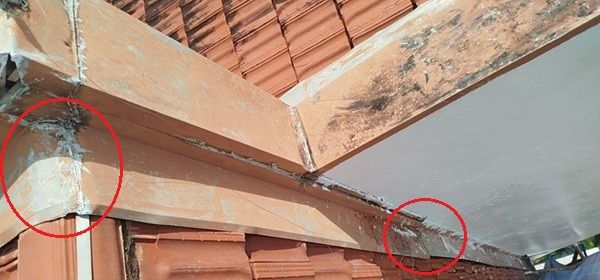
Installers of cement tile and clay tile roofing systems tend to procure standard off-the-shelf metal flashing roofing accessories, which may not conform to the unique detailing requirements presented by peculiar site conditions. Such off-the-shelf metal flashing roofing accessories are not formed with interlocking connection seams. Sealant is often used to seal the gaps which are presented in non-interlocking connections. As the sealant wear down with age and exposure to the weather elements, the water-tightness capabilities will be compromised in due course.
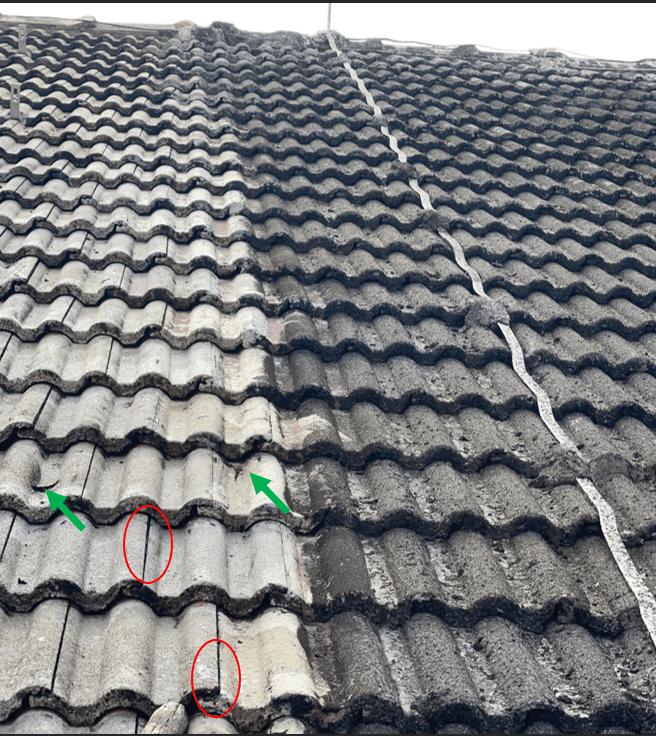
Example of displacement on cement roof tile systems
Example of displacement on cement roof tile systems (circled in red) and chipped-off tile constituent (green arrow)
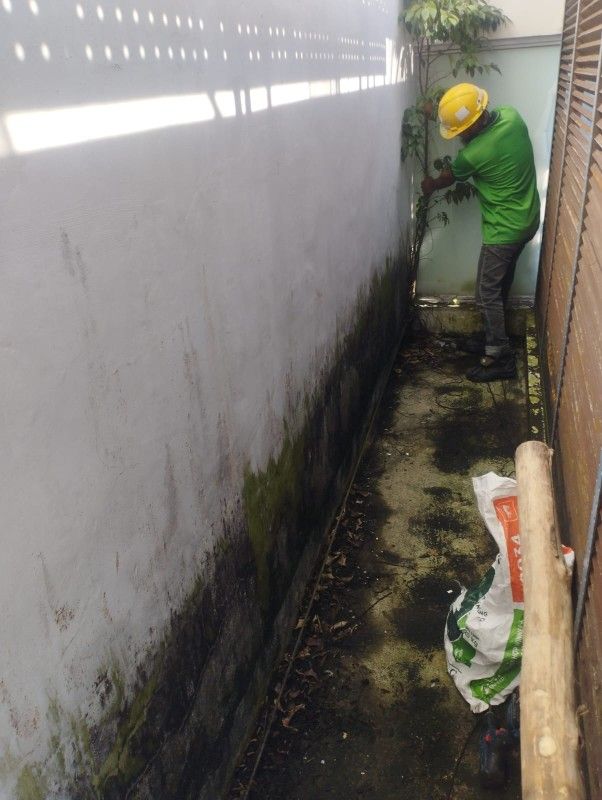
Example of cracked glazed clay tile
Example of cracked glazed clay tile, with sealant applied at the crack lines
Example of metal flashing installation
Example of metal flashing installation which do not fit the peculiar detailing requirements on site. Adjacent metal flashing components are installed with non-interlocking components. Sealant is abundantly used to bridge the voids between adjacent flashing components.
Possible Remedies for Clay Tile and Cement Tile Roofing Systems
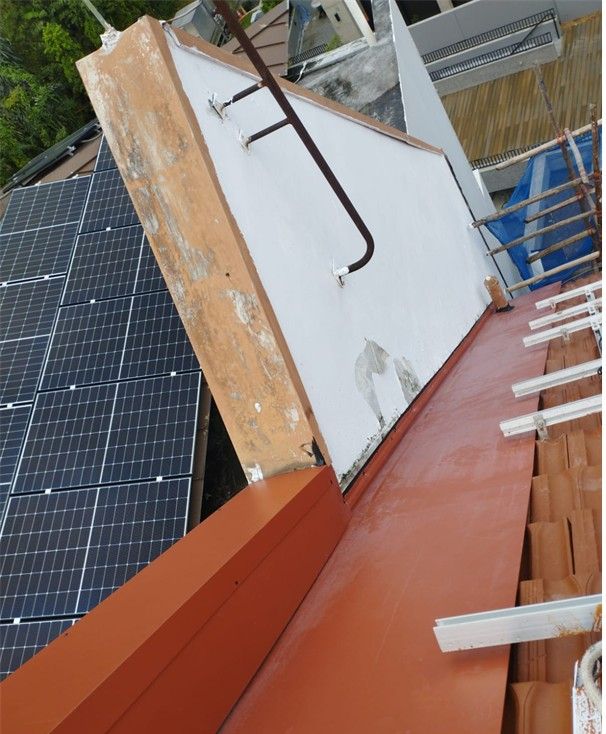
To resolve cracked roof tiles, direct replacement will be the most ideal. However, with the large variety of roof tile profiles, dimensional differences across different make and models of roof tiles, it is an often-uphill task to find a direct replacement for the affected tiles. Localised waterproofing can be performed on the cracked tile to restore the water-tightness capabilities of the roof tile, albeit with limited warranty tenure. A waterproofing membrane is recommended to be applied over repaired tile surfaces to prolong the water-tightness performance. To resolve the issues associated with displaced / damaged metal flashings and metal capping, we employ German roofing fabrication and installation principles in restoring the water-tightness of the flashing and capping, complete with obligatory interlocking components. This ensures long-term water-tightness performance, as opposed to metal flashing and metal capping systems formed with non-interlocking components, secured by exposed fasteners.
Example of a repaired metal capping / metal flashing system
Example of a repaired metal capping / metal flashing system using interlocking components for enhanced water-tightness
Reinforced Concrete Roofing Systems
Reinforced concrete roofing systems are constructed with varying waterproofing systems specified at the point of construction. To enhance the water-tightness capabilities of reinforced concrete roofing systems, torch-on membrane system and liquid applied waterproofing systems may be applied on to reinforced concrete roofing systems. The use of liquid applied waterproofing systems are often used to detail the upturn junctions on the reinforced concrete roofing systems e.g. ventilation pipes.
Common Issues with Reinforced Concrete Roofing Systems
As with all waterproofing membrane systems, there is a finite service lifespan. The textured granules will delaminate from the torch-on bituminous membrane aggregate, lapping joints may open-up with fair wear and tear. Liquid waterproofing membrane are often acrylic-based, with a finite lifespan. Blisters and bubbles may form on applied liquid waterproofing membrane due to pockets of trapped air or moisture within the reinforced concrete substrate. With passing age, the pockets will expand and crack, exposing the original reinforced concrete surface. The plastered surface of the reinforced concrete roof will eventually be exposed to the weather elements. As the plastered surface ages, water will seep through the cracks, resulting in water seepages. In some cases, vegetation can grow at the cracked reinforced concrete roof surfaces.
Example of blisters and bubbles
Example of blisters and bubbles forming on a reinforced concrete roofing surface applied with liquid-based waterproofing membrane
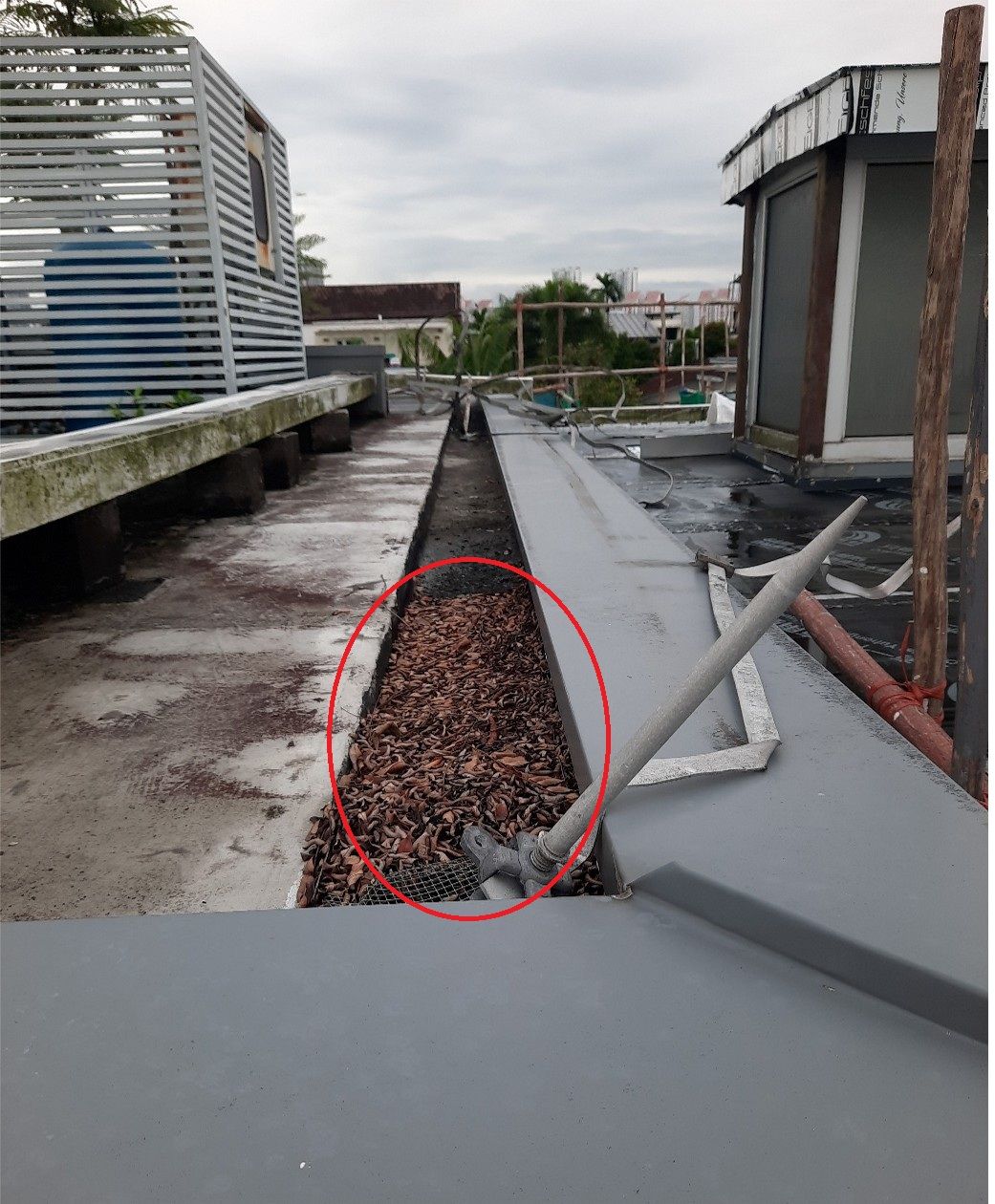
Example of accumulated leaves
Example of accumulated leaves on reinforced concrete roofing surface, resulting in blockage to the rainwater downpipe.
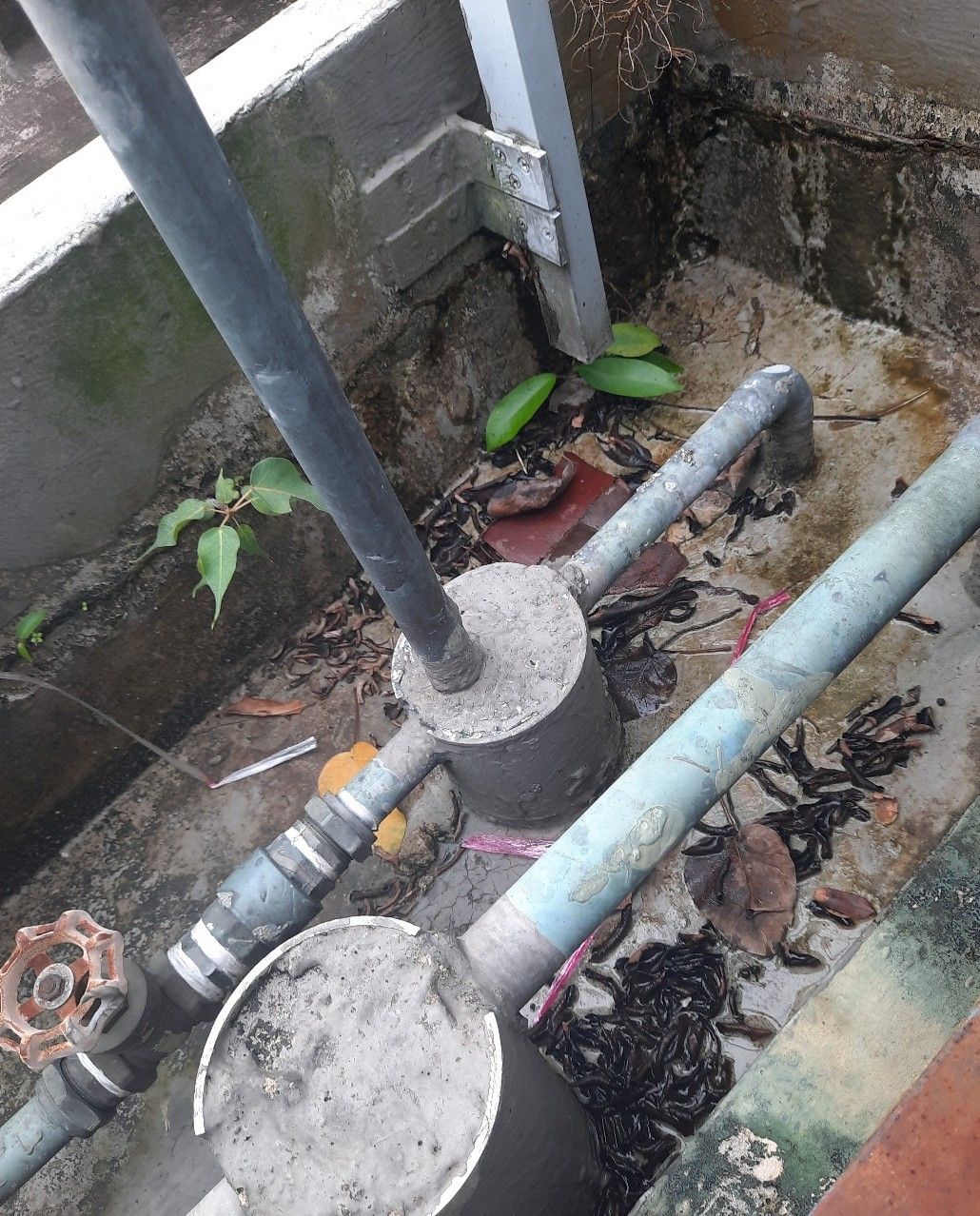
Example of vegetation growth
Example of vegetation growth on cracked reinforced concrete roofing surface
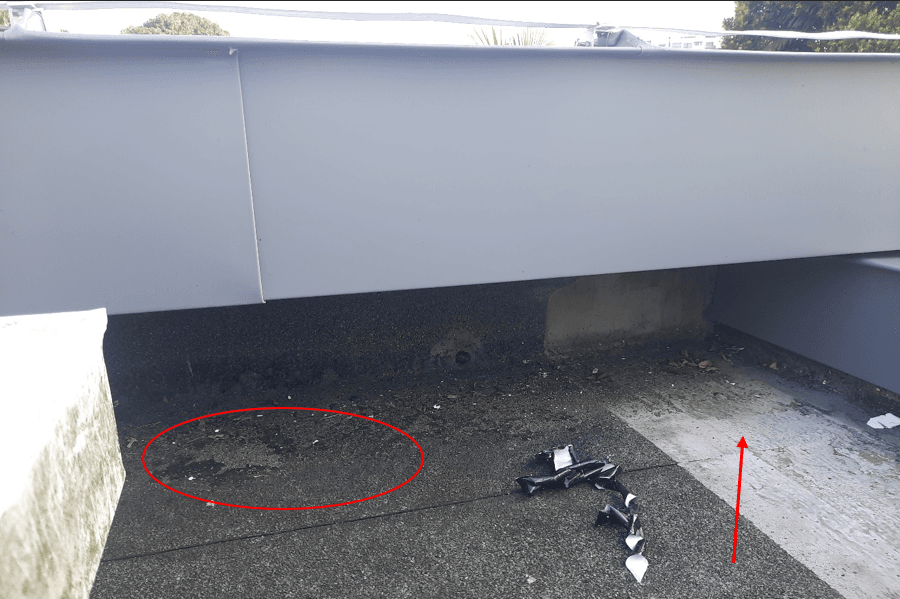
Example of delaminated granules
Example of delaminated granules from torch-on bitumen membrane. Note that the lapping joints of the touch-on bitumen membrane has been reinforced with liquid applied waterproofing membrane to prevent the joints from opening up.
Example of lapping joints
Example of lapping joints of the touch-on bitumen membrane, previously reinforced with liquid applied waterproofing membrane to prevent the joints from opening up.
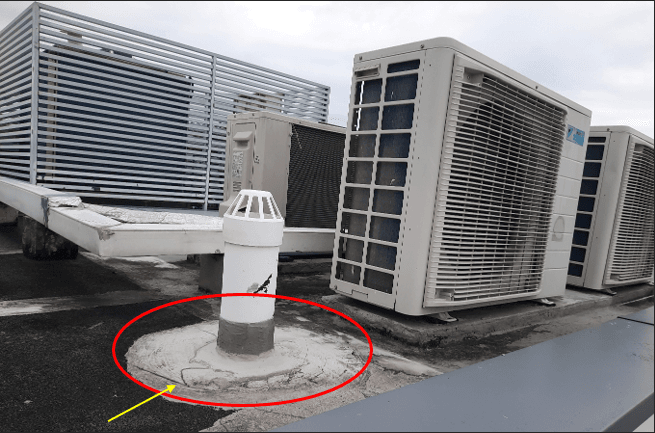
Example of liquid-applied waterproofing
Example of liquid-applied waterproofing membrane and non-shrink grout to detail the upturn connection of the ventilation pipe with respect to the reinforced concrete roof surface. Due to the differential expansion and contraction rates of the reinforced concrete, plaster, waterproofing membrane, cracks are visible.
Example of cracked reinforced concrete roof
Example of cracked reinforced concrete roof surface, resulting in water seepage and vegetation growth
Possible Remedies for Reinforced Concrete Roofing Systems
The waterproofing membrane on reinforced concrete roofing systems has to be applied periodically. For a more permanent solution, a metal roof cladding surface can be installed on top of reinforced concrete roofing systems.
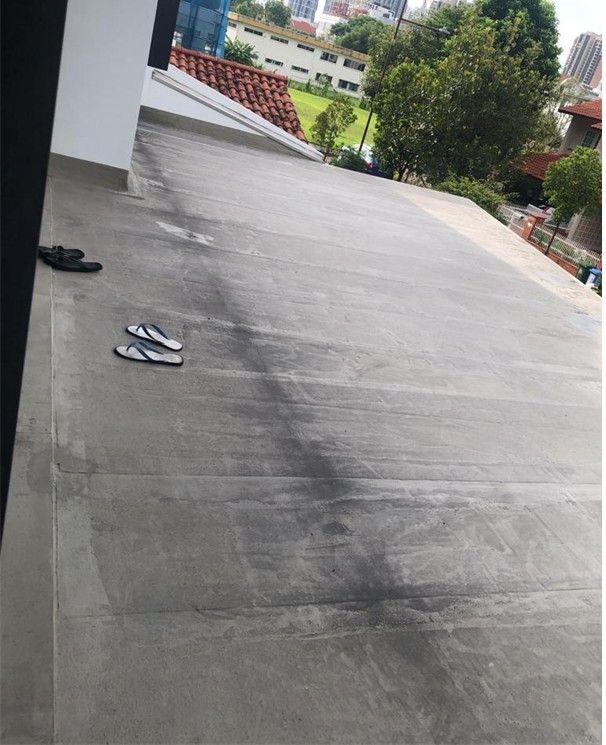
Example of treated reinforced concrete roofing system
Example of treated reinforced concrete roofing system with reported water seepages
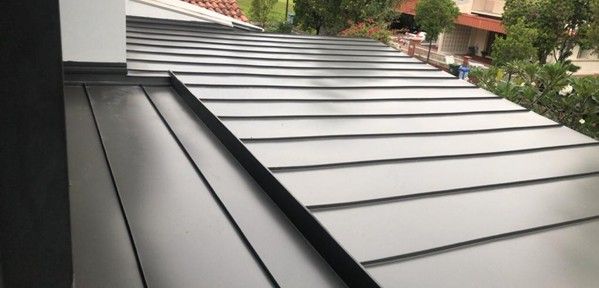
Example of reinforced concrete roof with metal overlay
Example of reinforced concrete roof overlaid with metal roofing system
Metal Roofing Systems
Metal roofing systems have gained popularity in the recent years, due to its low pitch requirement to facilitate efficient surface water discharge. Due to the lightweight system loading, metal roofing systems require relatively light-weight structures. The finishing materials vary from entry-level steel to mid-level aluminium. Where roofing budget is more generous, stainless steel, copper, titanium zinc roof finishing can be installed. While metal roofing systems should offer the best possible water-tightness performance due to its flexibility, tensile strength, the varying standards of fabrication, installation and detailing can affect the long-term water-tightness of metal roofing system.
Common Issues with Metal Roofing Systems
The long-term water-tightness performance of metal roofing systems are contingent on the following:
-
Quality of the paint coating material
-
Quality of the meal substrate
-
Thoroughness in the fabrication and installation of the connection details
-
The use of concealed fasteners (as opposed to exposed fasteners)
-
The paint coating type, the thickness of the paint coating offer different levels of protection to the metal substrate
In the following example, the metal roof surface experienced a combination of lackluster paint coating system, offering minimal protection to the steel substrate.
Consequently, surface corrosion and edge corrosion surfaced within ten years of installation. The water-seepage was exacerbated by the installation of lightning protection tape, which was punched through the roofing panel
Example of steel roof surface with corrosion
Example of steel roof surface experiencing edge corrosion and surface corrosion. Note that the lightning protection tape has been secured, by puncturing through the crest of the roofing panel.
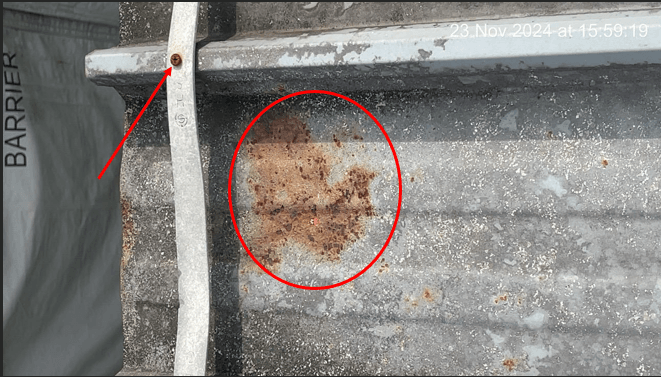
Another Example of steel roof surface with corrosion
Example of steel roof surface experiencing edge corrosion and surface corrosion
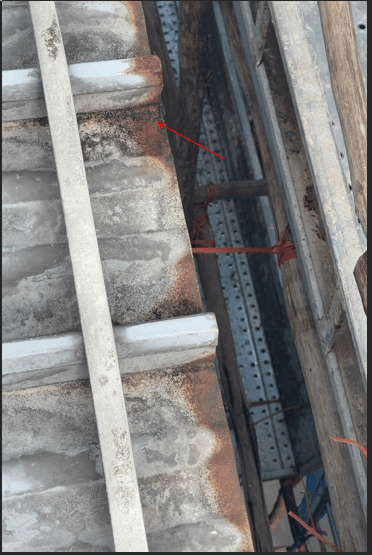
Example of metal roof with exposed fasteners
Example of a metal roof installation with pervasive use of exposed fasteners, poor detailing to connection details leading to water ponding
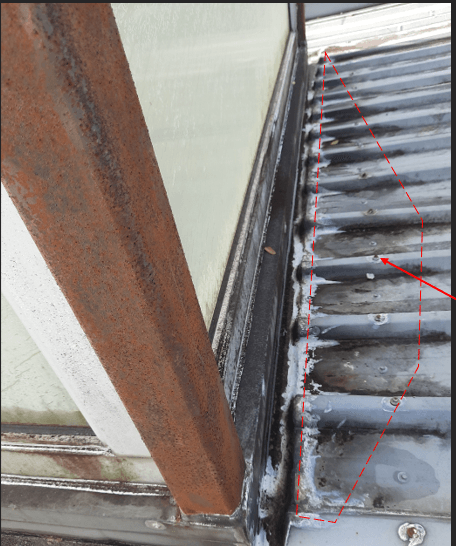
Example of metal roof with inappropriate sealant
Example of metal roof installation with exposed fasteners and use of inappropriate sealant (clear sealant is used for indoor applications)
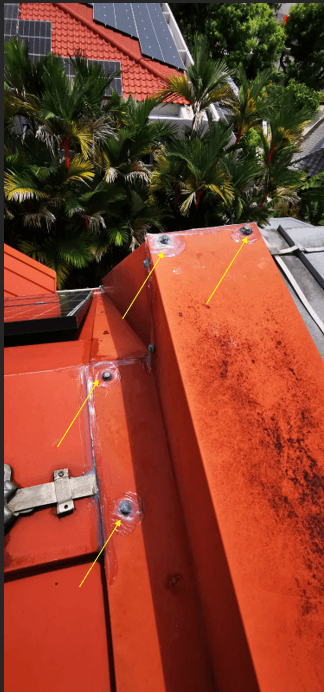
Possible Rectification of Metal Roofing Systems
The cheapest form of metal roofing system rectification involves the application of a fresh layer of waterproofing membrane onto the metal roof surface. This will prolong the useful lifespan of the paint coating system. However, the technique of applying waterproofing membrane over existing metal roof surface does not rectify the water seepage issues attributed to the use of exposed fasteners and poor detailing at the interfacing connections. To rectify the existing issues of metal roofing systems, we recommend the installation of a new metal roof finishing surface, complete with concealed fasteners and interlocking metal roofing panels. Non-puncture type lightning protection system will be installed after the new metal roof finishing surface is installed. We offer a fresh ten year water-tightness warranty for newly-installed metal roof finishing surface.
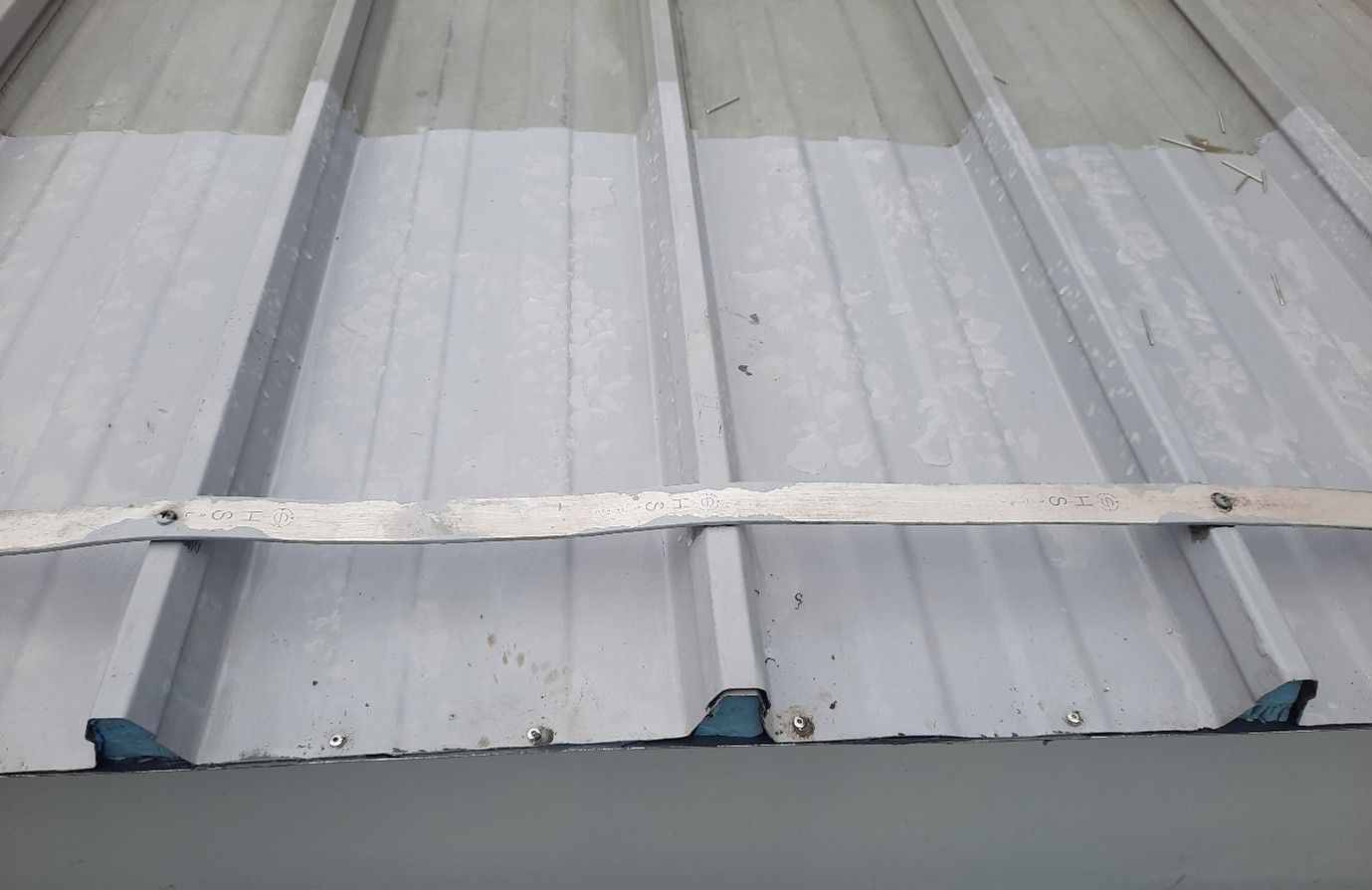
Example of rectified metal roofing using localised waterproofing technique
Example of a rectified metal roofing using localised waterproofing technique
Example of rectified metal roof based on German roofing principles
Example of a rectified metal roof based on German roofing principles
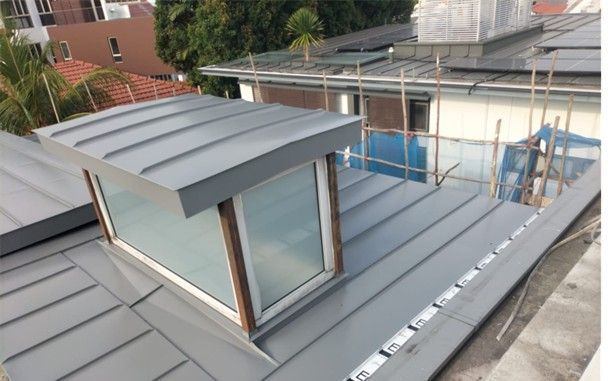
Example of rectified metal roofing with non-puncture type lightning protection system