Solar Inverter Selection Guide
Solar inverter, or solar panel inverter, convers the Direct Current (DC) output of solar panels to Alternating Current (AC). As the incoming supply from the power grid is supplied in AC, the inverter is essential for integrating solar energy for usage. Without which, the generated solar power is unusable for standard appliances, which require AC power to operate.
Table of Contents
- Basic Principles of Inverter Operation
- Types of Solar Inverters
- String Inverters
- Central Inverters
- Micro-inverters / Module-level Power Electronics (MLPE) Inverters
- DC Solar Optimiser / DC Power Optimisers
- Key Performance Metrics, Maximising Energy Harvest
- Assess the Likely Energy Consumption
- Sizing of solar inverter
- Conversion Efficiency
- Weighted Efficiency
- Maximum Power Point Tracking (MPPT) Capabilities
- Maximum Power Point Tracking Speed
- DC Input Voltage Range / MPPT Operating Voltage Range
- Power Factor Adjustment / Power Factor Correction
- Low Power Ride-Through (LVRT)
- Product Packaging and Functionalities
- High Altitude Applications
- Smart Features, Operations & Maintenance Support
- The Marking Plate and Technical Data Sheet
- Example 1
- Example 2
Basic Principles of Inverter Operation
The solar inverter receives DC power from the solar panels. With the aid of advanced electronic circuitry, the solar inverter converts to the DC input to an AC waveform, which is synchronized to the incoming AC power from the grid (frequency and voltage). Typically solar inverters provide additional functionalities, such as system management and performance analysis that would allow solar panel system owners to track the system’s output, efficiency and health in real time.
Types of Solar Inverters
String Inverters
String Inverters connect a series of solar panels to one inverter. The inverter then converts the combined DC power from these serially-connected solar panels into AC power.
The advantages of string inverters include:
-
Cost-effectiveness
-
Simplicity and flexibility in string configuration
-
Multi-channel Maximum Power Point Tracking (MPPT)
-
Superior heat dissipation
-
Easy maintenance String inverters are often deployed at residential rooftops, commercial buildings and mountainous installations. However, string inverters are not ideal with installations with shading issues, as the entire output from the affected string can drop drastically, if one solar panel is shaded.
Central Inverters
Central inverters have a centralized plant architecture, often sited at the most efficient location to connect to multiple DC outputs.
In order to aggregate the photovoltaic strings, central inverters usually need a combiner box that can combine as many as 20 photovoltaic strings. Approximately, ten combiner boxers will then connect to the inverter.
Central inverters could have approximately 2000-3000 panels operating from a single Multi Power Point Tracker (MPPT), leading to efficiency losses caused by module mismatch. The cost of cables is usually 35% higher with central inverters than with string inverters. As many photovoltaic strings rely on one inverter, equipment failure could mean greater downtime losses. Central inverters also take up more land area as they need to be housed, and possible shading losses from this need to be considered.
Micro-inverters / Module-level Power Electronics (MLPE) Inverters
Micro-inverters are small (hence the name) inverters that are installed at the actual panel. This is in contrast to regular string inverters, which are usually larger and are in a central place with access to multiple solar panels. Micro-inverters enhance efficiency, especially in situations where individual panels experience different shading or sunlight conditions, and to mitigate module mismatch losses, orientation mismatch losses.
The performance of solar systems can be improved through the implementation of micro-inverters. The Maximum Power Point Tracking (MPPT) refers to how solar inverters instruct a solar panel or an array to operate at a specific current and voltage combination that maximizes power output. With micro-inverters, MPPT can be done at the module level, rather than at the array level (as in the case with a string inverter).
DC Solar Optimiser / DC Power Optimisers
Similar to the microinverters, DC solar optimisers also convert solar energy from DC to AC. DC solar optimisers are attached to the junction box of individual solar modules. These devices maximise the module’s DC power output before conversion to AC power by an inverter.
The difference between microinverters and optimizers comes down to the process of conversion. DC solar optimizers also connect to the panels individually, optimises the DC power first before sending it to a central inverter to finalize the process of converting DC energy into AC. In contrast, micro-inverters convert the DC to AC right at the solar panel itself.
Key Performance Metrics, Maximising Energy Harvest
Selecting the right solar inverter is crucial for maximising efficiency and reliability of solar power system. Here are some considerations to make an informed choice.
Assess the Likely Energy Consumption
Make an assessment of how much energy you would use. If the anticipated electricity consumption is high, a more powerful solar inverter would be recommended. Do check against the past utility bills to have an idea.
Sizing of solar inverter
The solar inverter has to be right-sized against the power output of the solar panels. Too small, and the solar inverter will not be able to handle the energy needs. Too large, and the monies will be wasted on unused potential of the solar inverter
Conversion Efficiency
The conversion efficiency rating is defined as the ratio between the inverter input power from solar DC and inverter output power. This parameter indicates how will a solar inverter converts solar electricity into usable electricity. Typically, solar inverters with conversion efficiency ratings of 95% and above are considered to be highly efficient. Top-tier solar inverter brands can typically at least 98% conversion efficiency.
Weighted Efficiency
This measure takes into account the changing environmental conditions to which the solar inverter is exposed throughout the day, and over the year. Weighted efficiency provides a more accurate profile representation of the inverter operation. Solar inverter models with weighted efficiency of at least 97% should be prioritised for selection.
Maximum Power Point Tracking (MPPT) Capabilities
Solar inverters with multiple MPPT channels allow for the optimisation of power output from two or more independent solar panel strings, thereby enhancing overall system efficiency. In installations where shading is to be expected, two to four MPPT channels are recommended.
Maximum Power Point Tracking Speed
The tracking speed of solar inverters refers to how quickly it can make adjustments to the operating conditions of the solar panels to maximise power output. A faster tracking speed indicates that the solar inverter can react more rapidly to changes in solar irradiance and temperature, potentially enhancing higher energy production.
DC Input Voltage Range / MPPT Operating Voltage Range
The voltage range typically ranges between 80V to 600V. A wider voltage range (from 600V to 1100V) allows for better accommodation to diverse string designs and overloading.
Power Factor Adjustment / Power Factor Correction
Increasingly, solar inverters incorporate power factor adjustment to improve grid stability and efficiency, especially in grid-tied systems by adjusting the phase relationship between voltage and current. Solar inverters with 0.8 leading/lagging power factor are generally recommended for grid compliance.
Low Power Ride-Through (LVRT)
LVRT describes the requirement that generating plants, including solar systems, must continue to operate through short periods of low grid voltage, and not disconnect from the grid. Short-term voltage dips may occur, for example, when large loads are connected to the grid or as a result of grid faults like lightning strikes or short circuits. Grid-connected solar inverters need to have LVRT feature in-built to support the power grid for stability in supplies, and protect the power grid from fluctuating loads, thereby reducing the occurrence of blackouts.
Product Packaging and Functionalities
If you plan to install solar inverters outdoors, be sure to consider solar inverters with an ingress protection (IP) rating of at least IP 65. While most solar inverters are equipped with heat sink to promote cooling by natural ventilation, there are some models which incorporate active cooling / smart cooling technology by incorporating interior fans to remove warm air in a controlled manner. Active cooling / smart cooling technology seeks to enhance the long-term durability of solar panels, especially when the ambient temperature consistently is above 25oC.
High Altitude Applications
Solar inverters which are designed for applications above 3,000m in altitude are designated as inverters fit for high altitude applications. At higher altitudes, there is a reduction in air density and air pressure, which affects cooling performance of the solar inverters. Solar inverters designed for high altitude applications incorporate additional measures for heat dissipation, such as forced convection or liquid cooling.
Smart Features, Operations & Maintenance Support
Electricity is “invisible” to the naked eye. Smart features allow real-time monitoring, by allowing users to track every unit of produced solar energy, and consumption of active energy in real time, thereby managing it. Remote diagnostics capabilities enable quick identification of system defects, allow predictive and preventive maintenance to be organized, thereby maximizing productive hours, and keeping maintenance costs in control. The indication of Communication Protocols on the solar inverter model, is an indication of the existential smart features.
The Marking Plate and Technical Data Sheet
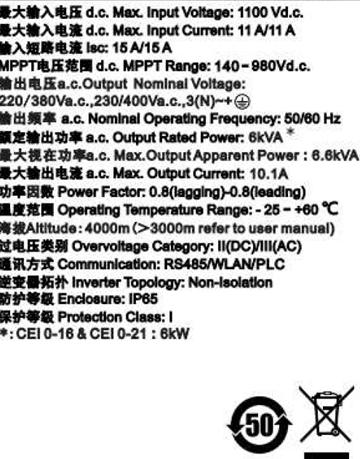
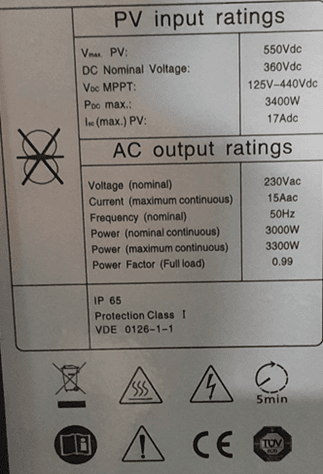
The marking plate and technical data sheet contains a wealth of information on the specifications on the solar inverter. We use the following marking plates from two examples of solar inverters as comparison. In summary:
-
Both Example 1 and Example 2 ae suitable for outdoor applications (IP65 rating and Protection Class I).
-
Only Example 2 has been designed for high altitude applications (4,000m, >3,000m) Only Example 2 has the ability to accommodate Smart Features (Communication protocol RS485/WLAN/PLC indicated).
-
Both Example 1 and Example 2 are meet grid compliance (minimum power factor correction value of 0.80 met). Example 1 has a better power factor adjustment / power factor correction capability of 0.99 as compared to Example 2 with 0.80.
Example 1
Example 2